
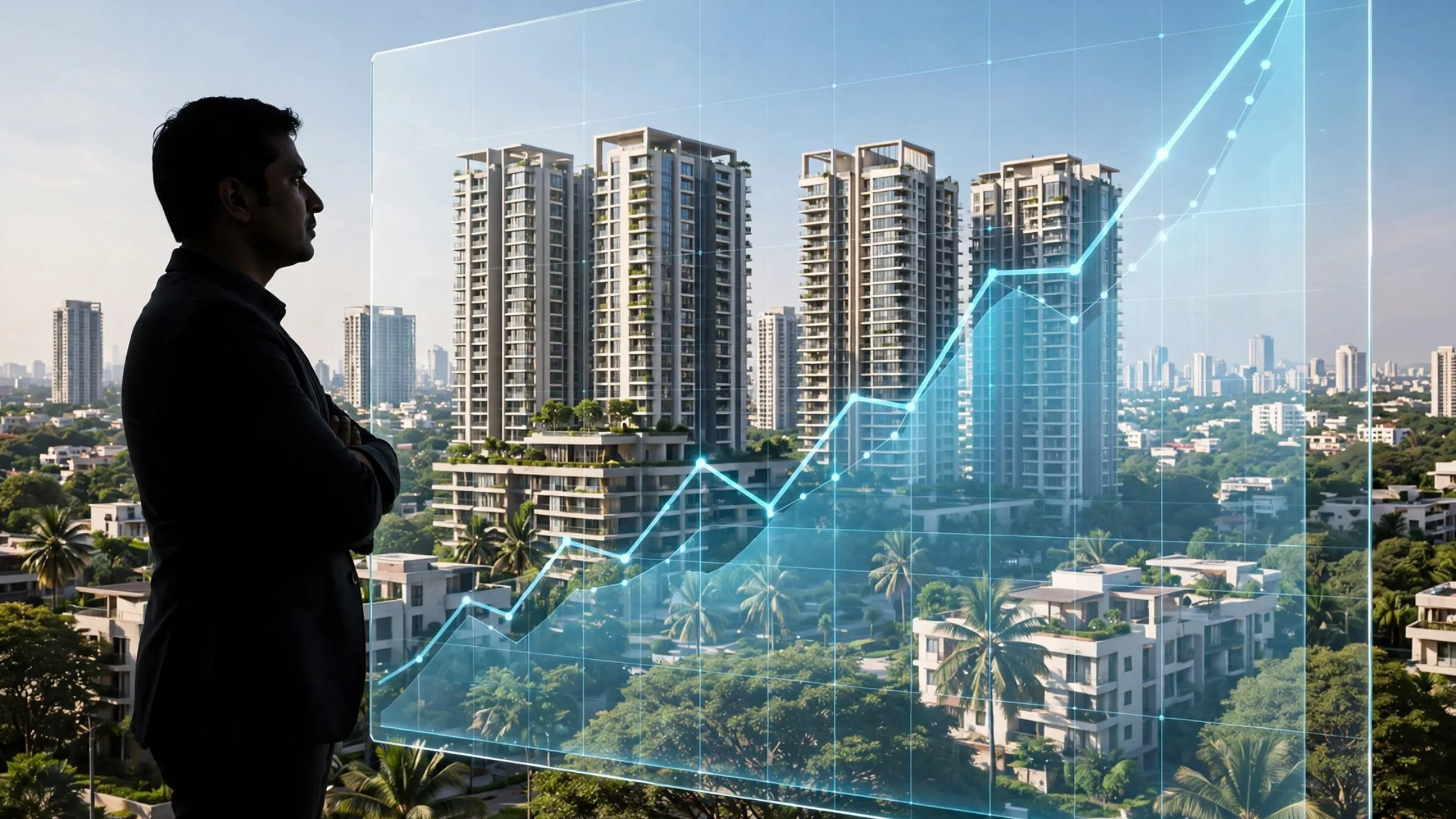
Someone who looked at a 3BHK in Whitefield four years ago and decided to wait is now looking at the same project, in the same tower, at a number that stings. That’s the honest starting point for any discussion of Bangalore property prices 2026 buyers are facing. Rates have moved up steadily across almost every corridor, and the easy entry points that existed a few years ago have largely closed. Naverah Assets helps buyers understand what is actually driving these price changes and where the value still makes sense.
The useful question isn’t whether prices went up. They did. It’s whether what you’re being asked to pay today is supported by something real, or whether you’re funding someone else’s optimism. With Naverah Assets, buyers can take a closer look at location, infrastructure, demand, and project fundamentals before making a property decision.
Rates vary far more by micro-market than by city. A tower on Sarjapur Road can quote 40 percent above a project six kilometres further out on the same road, and both can be reasonable, depending on access and completion status.
Broadly, peripheral corridors like Electronic City, parts of North Bangalore and outer Kanakapura Road sit at the accessible end. The tech belt through Whitefield, Marathahalli and Sarjapur occupies the middle. Hebbal, Yelahanka and the better ORR pockets sit above that, and central addresses like Indiranagar, Koramangala and Jayanagar operate in a different league entirely. Anyone quoting a single average property price Bangalore figure is flattening a market that doesn’t behave like one.
Four forces did most of the work behind Bangalore property prices 2026, and none of them looks like a bubble on its own.
• Input costs: cement, steel, labour and finishing materials have all risen, and developers have passed that through.
• Guidance value revisions: Karnataka’s revised guidance values raised the registered floor in many pockets, and market rates followed.
• Land scarcity near employment: there simply isn’t much developable land left close to the major tech parks.
• Demand depth: the city’s employment base keeps generating buyers with loan eligibility, particularly in the mid and premium segments.
Supply hasn’t kept pace in the segments people actually want. That imbalance, more than speculation, explains most of the movement in Bangalore home rates over recent years.
| Corridor | Relative price band | What you’re paying for | Watch out for |
|---|---|---|---|
| Electronic City | Accessible | IT belt access, expressway | Slower appreciation |
| North Bangalore / Devanahalli | Accessible to mid | Airport, aerospace, metro works | Thin social infrastructure |
| Whitefield | Mid | Tech parks, metro line | Older stock quality varies |
| Sarjapur / ORR | Mid to upper | Employment density, schools | Peak-hour traffic, drainage |
| Hebbal / Yelahanka | Upper | Manyata, road links | Premium already priced in |
| Central and old south | Premium | Scarcity, social infrastructure | Low rental yield |
Treat these as relative positions rather than quotes, since no single average property price Bangalore number survives contact with a specific project. Actual Bangalore flat prices depend on floor, view, developer reputation, construction stage and how much unsold inventory the builder is sitting on.
Look at three tests rather than sentiment.
Divide annual rent by asking price. If a comparable unit rents for far less than the price implies, you’re paying for expected growth rather than present value. That’s not automatically wrong, but you should know you’re doing it.
A common rule of thumb keeps total EMI under about 40 percent of take-home pay, with property cost around four to five times annual household income. Plenty of buyers in this city are stretching past that. Doing so on a single income with no emergency buffer is how a good asset becomes a bad decade.
Ask what the price assumes. If a rate reflects a metro station that’s operational, that’s paid-for value. If it reflects a tunnel road announced last year, you’re pre-paying for something that may arrive late or not at all.
Bangalore property prices 2026 hide the fact that the Bangalore housing market is genuinely two markets. Mid-segment homes near employment clear steadily because end-users need them. Luxury and large-format inventory in outer pockets moves slowly, which is exactly where the negotiation room hides.
Ready inventory tends to be priced firmly since developers know buyers pay for certainty. Projects at the mid-construction stage with slow sales are where a serious buyer can extract something. Unsold stock is the single best indicator of your bargaining position, and it’s usually visible if you ask the right questions on site.
The quoted per-square-foot rate is not the Bangalore property cost you’ll actually carry, and Bangalore property prices 2026 discussions rarely include the rest of it. Add stamp duty and registration per Karnataka’s applicable slabs, GST if the unit is under construction, floor rise, preferred location charges, club membership, corpus fund, advance maintenance, Khata transfer and legal fees. Interiors then land on top, typically running from a modest fit-out to something well past ten percent of the flat’s value.
Plan for roughly 8 to 12 percent above the agreement value before interiors. Lenders fund against agreement value only, so every rupee of that difference comes from your own savings on registration day.
You can’t control the market. You can control the terms.
1. Compare registered transaction values in the same project, not asking prices in listings.
2. Ask directly how many units remain unsold in the tower and on which floors.
3. Push on waivers such as floor rise, club charges or parking before pushing on headline rate.
4. Get your loan sanction first so you negotiate as a ready buyer.
5. Check completion status honestly, since delayed projects carry a real carrying cost you’ll pay in rent.
6. Verify A Khata, OC, RERA registration and the encumbrance certificate before any price discussion matters.
Waiting has a cost that people forget to count. Rent paid during a two-year wait, plus any further price movement, often exceeds what you hoped to save. If you’re buying a home to live in, the timing question matters less than affordability and location quality.
Investors face a harder call. Entry at current levels in an already-mature corridor limits upside, so the case rests on emerging areas with funded infrastructure and a holding period measured in years, not months. Bangalore property prices 2026 reward patience and punish borrowing stretched past comfort. This is general information rather than investment advice, and your own numbers should be reviewed with a qualified advisor.
A sharp citywide correction looks unlikely while employment demand holds and land near tech corridors stays scarce. What’s more plausible is uneven movement, with strong micro-markets holding firm and oversupplied outer pockets flattening. Price growth slowing is a very different thing from prices falling, and buyers often conflate the two.
Pockets in North Bangalore beyond Yelahanka, sections of Kanakapura Road and parts of the Electronic City belt still carry accessible entry points with real infrastructure. Against Bangalore property prices 2026 elsewhere in the city, value here means a defensible price for what exists today rather than a promise of doubling. Check approvals and water availability carefully in any outer layout.
In Karnataka these are charged on slabs tied to property value, and together with cess and registration fees they add a meaningful percentage to your outflow. Ask for the exact working on your specific price band, since the rate applied differs across value bands and rules are revised periodically.
Usually the headline rate is lower, but GST applies and you pay rent while waiting. Factor in construction risk and delay history for that developer. A completed unit priced a little higher can work out similar or better once you total the rent, tax and time you’d otherwise spend.
Bangalore property prices 2026 are high by historical standards, and they’re mostly backed by things you can verify: employment, scarcity near job centres, higher input costs and revised guidance values. That doesn’t make every project worth its asking rate. Run the rent test, the income test and the infrastructure test on any specific unit before you accept the number in front of you. Buy for use and location quality first, and treat appreciation as a bonus rather than the plan. A home you can comfortably afford in a corridor you understand ages far better than a stretched purchase in a fashionable one.
If you’re weighing a shortlist, a conversation with Naverah Assets can help you check whether a quoted rate reflects the corridor’s real value. For practical Bangalore property updates, follow Naverah Assets on Instagram and stay informed.


