
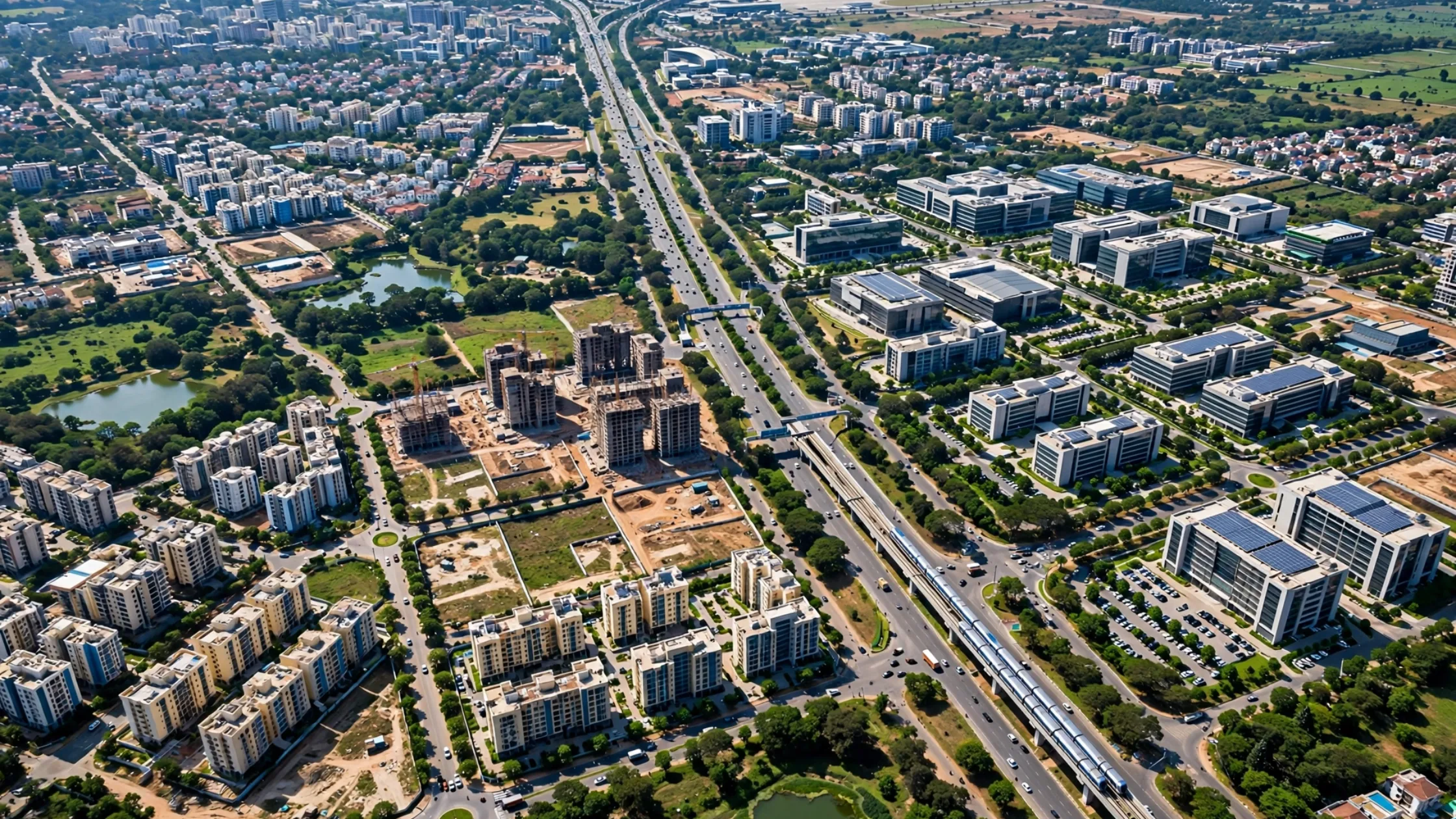
Ask five people where to buy in this city and you’ll get five confident, contradictory answers. One swears by Devanahalli because of the airport. Another says only Sarjapur makes sense. The truth is that the best areas to buy property in Bangalore depend on what you’re buying it for, and on how long you can leave your money in the ground.
An end-user commuting daily to Manyata has a completely different shortlist from an investor happy to hold land for eight years. Naverah Assets helps buyers understand these differences and evaluate locations based on connectivity, infrastructure, pricing, and long-term potential. This Bangalore property guide walks the major corridors, what they cost now, what’s driving them, and where the risks sit. For buyers comparing different parts of the city, Naverah Assets can also help make the property search more focused and practical.

Before names, use filters. Infrastructure that is funded and under construction beats infrastructure that is announced. A metro line with piers already up changes commute maths within two or three years; a proposed alignment on a map may not move for a decade.
Employment density is the second filter. Areas within a reasonable drive of large office clusters hold rental demand even in a soft year. Third, check approvals: BBMP or BDA jurisdiction with A Khata behaves very differently at resale from a BMRDA layout on B Khata. Fourth, look at absorption, meaning how many units actually sell rather than how many launch.
North Bangalore has been the loudest story for several years, and it earns a place on most lists of the best areas to buy property in Bangalore for defensible reasons. The airport, the Aerospace Park, business parks along Bellary Road, and metro extension work have all landed in the same geography.
Plots and villa projects dominate here. Entry rates are the most accessible among the property hotspots Bangalore 2026 conversations keep circling, though “cheap” stopped being accurate a while ago. The catch is holding period. Social infrastructure, meaning schools, hospitals and daily retail, is still filling in, so this suits investors with patience rather than families needing everything within two kilometres today.
More settled, more expensive, and easier to rent out. Hebbal’s connection to Manyata Tech Park keeps demand steady, and Yelahanka has genuine neighbourhood character rather than only new towers. Among top property locations Bangalore buyers name, these two consistently balance liveability with appreciation.
Whitefield went through a rough patch when commuting became painful, then metro connectivity put it back on the shortlist for working families. The stretch from Marathahalli through Bellandur to Sarjapur Road still carries the densest concentration of tech employment in the city, which is why rental demand rarely dries up.
Sarjapur Road remains one of the more debated Bangalore investment locations. Prices have risen sharply and peak-hour traffic is genuinely bad, yet inventory keeps clearing because of proximity to Wipro, RGA Tech Park and the schools families want. Buy here for rental income and end-use, not a quick flip.
On a tighter budget, Electronic City, Kanakapura Road and Bannerghatta Road offer lower entry points than the eastern corridor. Kanakapura Road benefits from an operational metro line and wider road, which is exactly the kind of funded infrastructure worth paying for. Electronic City suits buyers working in that belt, though its appreciation has been slower than the north over recent cycles.
JP Nagar, Jayanagar and Banashankari sit in a different category. Established, well-served, expensive, and unlikely to double quickly. If you want a home that holds value and rents easily rather than a growth bet, these deserve a place on any serious Bangalore property guide.
| Corridor | Indicative rate (per sq ft) | Main driver | Best suited to |
|---|---|---|---|
| Devanahalli / airport belt | Lower band | Airport, Aerospace Park | Long-hold plot investors |
| Hebbal / Yelahanka | Upper-mid to premium | Manyata, road and metro links | End-users, rental buyers |
| Whitefield | Mid to upper-mid | Tech parks, metro | Rental income, families |
| Sarjapur / ORR | Mid to upper-mid | Employment density, schools | End-users with a long view |
| Electronic City | Lower-mid | IT belt, elevated expressway | Budget end-users |
| Kanakapura Road | Lower-mid | Metro, road widening | Balanced growth and use |
| Central / South established | Premium | Scarcity, social infra | Capital preservation |
Rates are indicative and shift with project quality, floor and developer. Compare recent registered transactions, not asking prices.
The best areas to buy property in Bangalore change completely once you name your objective. A shortlist that suits a rental investor is often wrong for someone chasing capital growth.
Stay close to employment. The strongest yield pockets sit beside the tech parks: Whitefield, Sarjapur Road, Hebbal and pockets near Outer Ring Road give the most reliable tenant flow. Yields in Bangalore generally sit in a modest range compared with the price paid, so treat rent as a holding cost offset rather than the main return.
Look at where funded infrastructure lands in the next three to five years and buy just ahead of it: the airport belt, the peripheral ring road alignment, the outer ends of metro extensions. Expect slower years in between and don’t buy with money you might need at short notice.
Different corridors carry different paperwork risks, and this is where good residential investment areas turn into bad purchases. Paperwork, not location, decides most disputes.
• Khata classification: A Khata is materially easier for loans and resale than B Khata.
• Approving authority: BDA, BBMP, BMRDA and panchayat approvals are not equivalent. Check which applies.
• RERA Karnataka: verify registration, approved plans and complaint history on the portal.
• Encumbrance certificate: pull 30 years and read the title chain, including the mother deed.
• Conversion: for plots, confirm agricultural land has valid DC conversion.
• Buffer zones: check lake and rajakaluve buffer maps before signing anything near water bodies.
Even the strongest residential investment areas have soft spots, and Bangalore’s rains expose bad drainage fastest. Low-lying pockets near Bellandur, Varthur and parts of the ORR flood in a heavy spell, and that history sticks to resale value. Water supply is the other quiet issue: many peripheral areas run on borewells and tankers rather than Cauvery lines, a real monthly cost.
Infrastructure timelines slip. A tunnel road or metro phase announced for a certain year often lands late, so build your case on what exists plus what is genuinely under construction. This is general information, not investment advice, and a qualified advisor should review your specific plan.
Electronic City, Kanakapura Road, parts of North Bangalore and outer Whitefield offer workable entry prices with real infrastructure. Prioritise a completed or nearly complete project with A Khata and clean approvals over a cheaper unit in an unclear jurisdiction. Your first purchase should be easy to sell later.
For patient buyers, yes. The airport belt scores well on funded infrastructure and steady institutional activity, though social infrastructure lags in outer pockets. Expect a holding period of five years or more before meaningful appreciation, and check water availability and approach road quality before committing to any specific layout.
Plots historically appreciate faster in growth corridors but produce no rental income and carry higher title and encroachment risk. Apartments give rent from day one and easier financing. Many buyers hold both, using an apartment for use or income and a plot in a developing belt for longer-term growth.
Plan for roughly 8 to 12 percent above the quoted price, covering stamp duty and registration, legal fees, Khata transfer, corpus and advance maintenance, and interiors. Lenders fund against agreement value, so anything above that comes from your own funds on registration day.
There isn’t a single winner. The best areas to buy property in Bangalore for a family needing schools next year aren’t the ones an investor with a decade of patience should chase. North Bangalore carries momentum, the eastern belt carries tenants, and the established south carries stability. Match the corridor to your horizon, verify approvals area by area, and treat any property hotspots Bangalore 2026 list, this one included, as a starting point rather than a verdict. The right pocket is the one that fits your horizon and your monthly outflow, not the one with the loudest story attached.
If you’re narrowing down a shortlist, a conversation with Naverah Assets can help you test your assumptions against current ground realities and compare suitable options. For practical Bangalore property insights, Naverah Assets is also worth keeping on your radar.
Follow us on Instagram for fresh property updates.


