
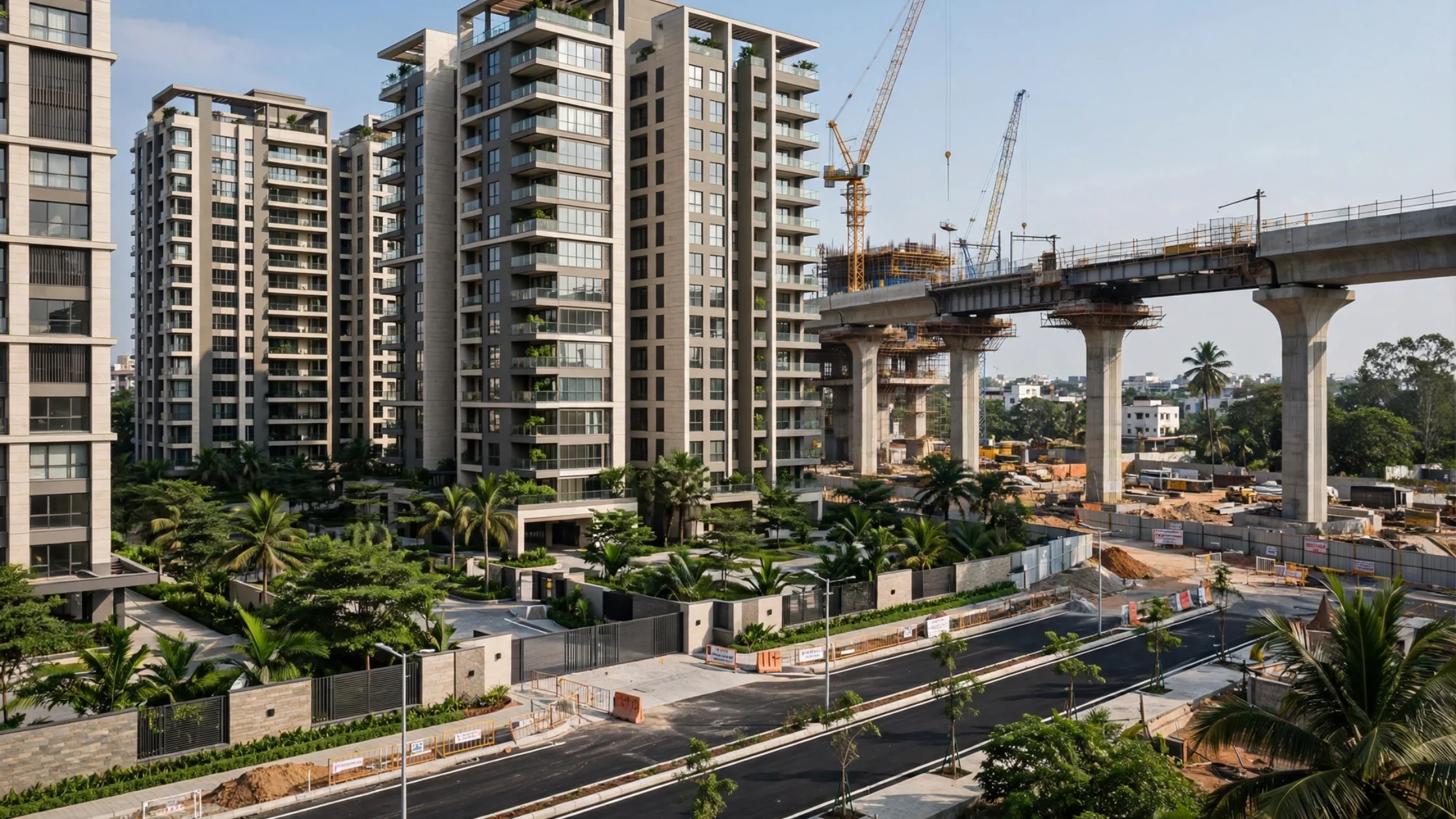
Stand at Silk Board on a weekday evening and you understand the appeal instantly. An hour to cover eight kilometres, every day, for years. That commute is why buyers now shortlist properties near upcoming metro lines in Bangalore before they look at floor plans, and why a two-kilometre difference in address can change a price by a noticeable margin. Naverah Assets helps buyers understand these location-based factors while exploring suitable property options.
The catch is that “upcoming” covers everything from lines with trains already testing to alignments that exist as a sanctioned drawing. Those two situations carry very different risks. Here’s how to separate the stretches that are physically being built from the ones still waiting, plus what to check before you commit. With guidance from Naverah Assets, buyers can evaluate connectivity, development timelines and the practical factors that matter before making a property decision.
A station changes the tenant pool. Someone working near an operational line will pay a premium to live within walking distance, because it converts an unpredictable 70-minute drive into a predictable 35-minute ride. Rental demand around stations tends to be deeper and less seasonal.
Resale follows the same logic. Buyers who can’t afford a car park, or who don’t want a second car, filter listings by station proximity. That widens your exit options later. The effect is strongest within roughly a kilometre of a station, weakens noticeably beyond two, and mostly disappears when the walk involves crossing a highway with no footpath.
Timing is the variable people get wrong. Prices in Upcoming Metro Areas Bangalore buyers watch tend to move in two steps: a rise when construction visibly starts, and another when services actually begin. Buying after both means paying for gains that already happened.
The line running along the ORR between Silk Board and K R Puram serves the densest office cluster in the city, covering Bellandur, Marathahalli and the surrounding tech belt. Construction here has been visible for years. Bangalore Metro Corridor Properties along this stretch already command a premium, and supply is heavy, so negotiate on price rather than assuming automatic appreciation.
The extension heading north from K R Puram towards Hebbal, Yelahanka and the airport is the most consequential for long-horizon buyers. It links a growing employment base with the airport and unlocks pockets that were previously commute-limited. Entry prices remain lower than the east in many stretches, though the wait is longer.
Extensions towards Electronic City, Bommasandra, Kanakapura Road and the western stretches around Kengeri and Challaghatta bring metro access to corridors that have long relied on congested arterial roads. Phase 3 proposals along the western ORR and the Sarjapur alignment sit earlier in the pipeline, and Future Metro Areas Bangalore investors bet on there should be treated as long-dated options rather than near-term certainties.
| Stretch | Status maturity | Entry price today | Best suited to |
|---|---|---|---|
| ORR east (Silk Board–K R Puram) | Advanced construction | High | Rental income now |
| K R Puram–Hebbal–Airport | Under construction | Moderate | Seven to ten year hold |
| Electronic City / south | Recently operational | Moderate | End users, steady rent |
| Kanakapura Road | Operational | Moderate | Value-conscious families |
| West (Kengeri–Challaghatta) | Operational | Lower | Affordability-led buyers |
| Sarjapur and western ORR proposals | Planning stage | Lowest | Patient, risk-tolerant capital |
Read the “status maturity” column first. It’s the single best predictor of whether the price you pay reflects a real asset or a promise. Homes Near Upcoming Metro stations that are already casting piers behave differently from Metro Expansion Property Bangalore listings priced off a merely sanctioned line.
There’s a rough window that has worked repeatedly across Bangalore’s earlier phases:
1. Too early: alignment announced, no land acquisition. Cheapest, and the timeline can slip by years.
2. Reasonable: piers and stations visibly under construction, completion within a few years. Prices have moved once, but the second move is still ahead.
3. Late: services running. You pay for the convenience immediately and give up most of the upside.
If you need rent from day one, buy late and accept the price. If you can wait, the middle window generally gives the better risk-adjusted entry, and it’s where most successful buyers of properties near upcoming metro lines in Bangalore have historically stepped in.
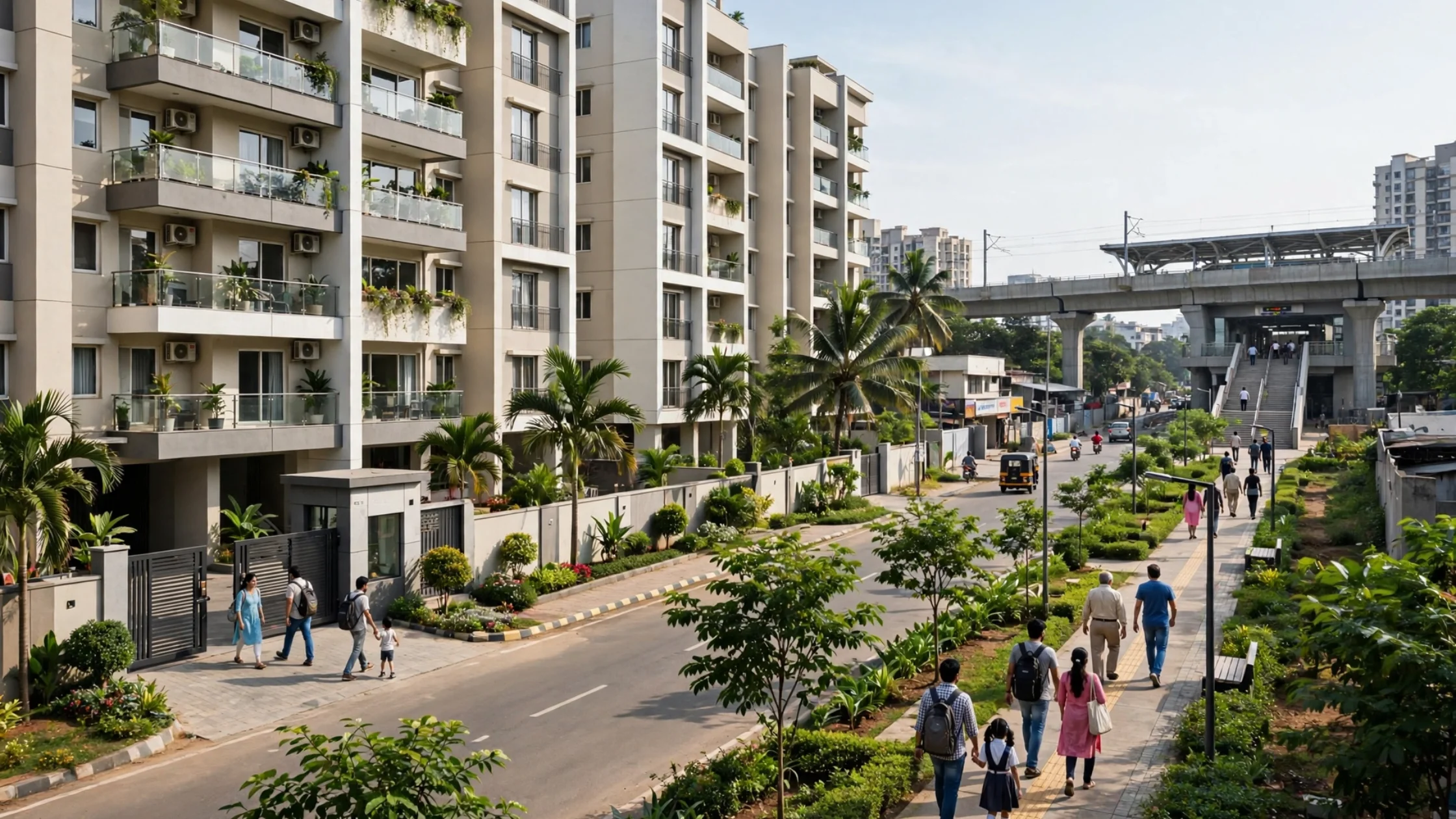
Metro proximity doesn’t fix a bad property. The usual checks still decide whether you can sell or finance it later.
• Actual walking distance to the station entrance, not straight-line distance on a map. Walk it once.
• RERA Karnataka registration and the declared completion date for the project.
• Khata status, ideally A Khata, plus BBMP, BDA or BMRDA approvals matching the sanctioned plan.
• Encumbrance certificate and mother deed reviewed by your own advocate.
• Road widening notifications, since metro corridors often trigger acquisition along approach roads.
• Water supply, because station proximity means nothing if the building runs on tankers.
That last pair catches people out. Buyers focus on the line and forget that the property sits on a road scheduled for widening, or outside the piped network. Bangalore Metro Corridor Properties fail these basic checks as often as anything else in the city.
Living beside an elevated viaduct isn’t uniformly pleasant. Units directly facing the alignment can get noise and reduced privacy on lower floors, and some buyers actively avoid them. The premium usually goes to properties a short walk away rather than immediately adjacent.
Construction years are disruptive too. Approach roads narrow, dust is constant, and local traffic worsens before it improves. If you’re buying to live in and the line is three years from completion, budget for that experience honestly.
Then there’s the pricing problem. Sellers in Upcoming Metro Areas Bangalore agents promote often quote as though the line is already running. Paying a fully-realised premium for an asset that’s still under construction leaves you carrying the delay risk with none of the discount. Ask what similar units sold for two years ago, and judge whether the gap is justified.
If your priority is rental yield within a year, look at stretches where trains are already running and employment is nearby. Occupancy is quicker and tenants pay for the connectivity today. Expect modest appreciation, since much of it has happened.
If you’re building long-term capital, the north Bangalore and airport corridor offers more room, provided you can hold through quiet years. Future Metro Areas Bangalore investors favour reward patience more than timing. And if you’re buying a plot rather than an apartment, approval status matters more than the station, because an unapproved plot near a metro line is still an unapproved plot.
It varies by stretch and how advanced construction is. Properties within comfortable walking distance of operational stations generally rent and resell more easily than comparable units further away. Announced-but-unbuilt alignments carry far less premium, and paying for one as though it’s complete is the common mistake.
It’s the highest-risk entry point. Sanctioned alignments have shifted, been re-phased or delayed in the past, and your capital sits idle meanwhile. If you buy this early, make sure the property stands on its own merits, with employment access and clean approvals, so you aren’t dependent on the line alone.
Corridors with established schools, hospitals and daily retail work best for families, particularly along the northern stretch around Hebbal and Yelahanka and the southern extensions. Homes Near Upcoming Metro stations in still-developing pockets can be quiet for years, which suits investors more than households with children.
Not necessarily, but units directly facing an elevated alignment on lower floors can see noise and privacy concerns, and some buyers rule them out. Higher floors set slightly back typically fare better. Visit at peak hours before deciding, since perception varies widely between individual buyers.
Buying properties near upcoming metro lines in Bangalore works when you separate what’s built from what’s promised. Favour stretches where construction is physically visible, walk the actual route from the flat to the station entrance, and check title, khata and road widening notices with the same seriousness you’d apply anywhere else. Judge the asking price against what the corridor traded at before the hype, not against what agents expect after the line opens. Connectivity genuinely improves rental depth and resale liquidity over time, but only for buyers who pay a sensible entry price. This is general information, not investment advice.
If you’re weighing up your options, Naverah Assets can help you explore properties and understand local market options, while an independent legal advisor can provide advice matched to your situation. Naverah Assets is also a useful starting point when comparing locations, projects and connectivity.
Follow Naverah Assets on Instagram for more property updates.


