
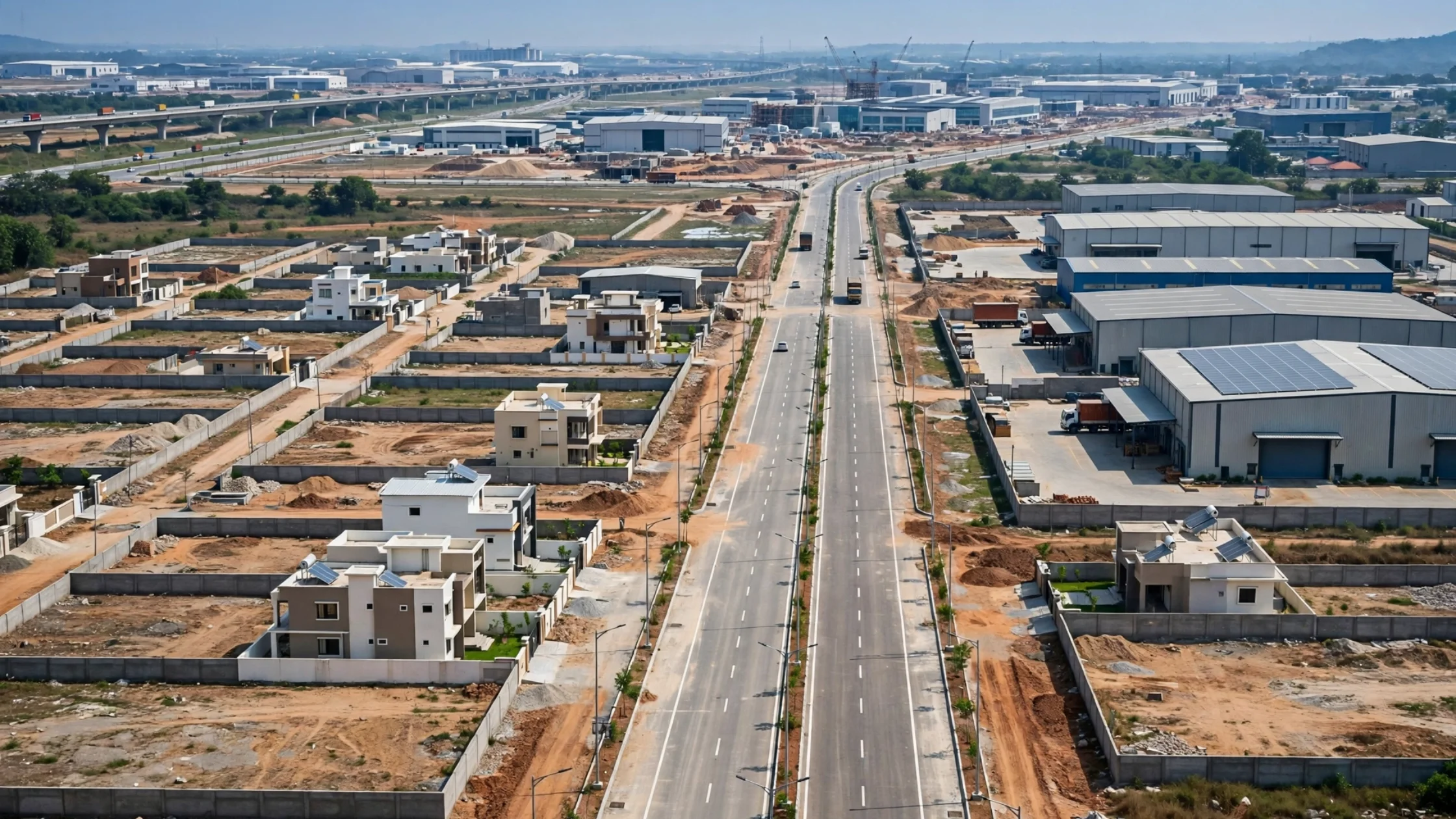
Someone at a family function always has the story. Bought a site off Hennur Road for a price that sounds made up now, sat on it twelve years, sold it to a builder. What the story leaves out is the decade of dust, the litigation scare in year four, and the two neighbouring layouts that never took off. Naverah Assets believes picking property appreciation areas in Bangalore is less about spotting the next hotspot than reading which infrastructure is actually funded.
This piece looks at where prices have room to move, what triggers that movement, and how long you should expect to wait. With insights from Naverah Assets, it offers general information to help readers understand Bangalore's property market. It’s general information, not investment advice.
Appreciation follows people, and people follow jobs. Everything else is secondary. It’s the pattern behind nearly every one of the property appreciation areas in Bangalore that has actually paid off.
A metro line with tunnelling underway changes land values. A line in a feasibility study does not, at least not durably. The same holds for road widening, ring road proposals and suburban rail. Prices rise on announcement, flatten for years, then rise again when the thing opens. Buy at the announcement peak and you may spend five years going nowhere.
Corridors that got offices first, such as Whitefield and Manyata, absorbed housing quickly. Corridors that got housing first waited for tenants who arrived slowly. Check where companies are signing leases, not where billboards promise a business district. Any forecast of future property value Bangalore buyers see at a sales office is only as good as the employment assumption under it.
North Bangalore remains the most discussed part of the market, for defensible reasons. The airport anchors it, the aerospace and hardware parks near Devanahalli employ real people, and the elevated expressway made commutes predictable. Land parcels were large, so layouts are planned rather than improvised.
Devanahalli, Bagalur, Chikkajala and the Doddaballapur Road stretch sit at different points on the same curve. Closer pockets have already repriced. Outer ones carry more upside and more waiting. Among high appreciation locations Bangalore buyers shortlist, this belt has the clearest long-term logic, provided you can hold seven to ten years without needing the money back.
East Bangalore is mature, which changes the maths. Whitefield and Sarjapur Road already carry high entry prices, so gains from here are likely to be steady rather than dramatic. What still moves is the second ring: Varthur, Gunjur, Chandapura and the pockets heading towards Attibele.
These property growth corridors depend heavily on road capacity. Anyone who has sat through the Marathahalli to Sarjapur crawl on a Tuesday evening understands why. Where connectivity genuinely lands, prices respond. Where it stalls, so do values, and that risk is real rather than theoretical.
Metro connectivity has reshaped parts of the south. Kanakapura Road, Bannerghatta Road and the stretch towards Electronic City behave far better than they did as pure bus corridors. Stations create a walkable premium of roughly five to fifteen per cent over comparable stock a few kilometres away, and it tends to hold. Some of the steadiest property appreciation areas in Bangalore over the past five years sit within a ten-minute walk of a working station.
Jigani, Anekal and the areas past Attibele are the speculative end of the same story. Cheaper entry, longer wait, weaker rental support in the meantime. They belong in a portfolio only if the rest of it is already stable. The real estate growth areas in the south that have delivered consistently are the ones where schools, hospitals and employment filled in behind the road, rather than ahead of it.
Ranges below are indicative and depend on specification, approval status and how the parcel is packaged.
| Corridor | Entry level | Likely horizon | Main risk |
|---|---|---|---|
| Devanahalli, Bagalur | Moderate | 7 to 10 years | Slow occupancy |
| Thanisandra, Hennur | Higher | 4 to 6 years | Already repriced |
| Varthur, Gunjur | Higher | 4 to 7 years | Road congestion |
| Sarjapur outer | Moderate | 5 to 8 years | Approval gaps |
| Kanakapura Road | Moderate | 4 to 7 years | Supply glut |
| Jigani, Anekal | Low | 8 to 12 years | Thin demand |
| Hoskote | Low | 7 to 10 years | Industrial mix |
Not everything marketed as the next big thing deserves your money. The warning signs repeat:
• Layouts with revenue survey numbers and no BMRDA or BDA approval, sold on a promise that regularisation will follow.
• B-Khata inventory discounted generously until you try to get a home loan or resell.
• Plots priced off a proposed road alignment that has changed twice already.
• Promoters whose earlier deliveries run years behind their RERA Karnataka timelines.
Genuine Bangalore investment hotspots have boring paperwork and visible construction. The ones that lose money have brochures instead. Among the high appreciation locations Bangalore agents push hardest, the ratio of glossy renders to approval documents tells you most of what you need to know.

Appreciation you can’t realise isn’t appreciation. Before you sign anything, work through the essentials:
1. Verify the RERA Karnataka registration number and read the declared timelines and complaint history.
2. Insist on Khata A, and treat B-Khata as a discount reflecting real limitations rather than a bargain.
3. Take a thirty-year encumbrance certificate, then read the sale deed against the mother deed for a clean chain of title.
4. Confirm BBMP, BDA or BMRDA approval, and check conversion order status for former agricultural land.
5. Factor stamp duty, registration and development charges into your entry cost before calculating returns.
A property lawyer’s fee is small against the amount at stake. Buyers comparing property appreciation areas in Bangalore often spend weeks on price per square foot and an afternoon on title, which is the wrong ratio. Real estate growth areas with messy documentation stay cheap for a reason.
Forget doubling in three years. Across most established corridors, sensible expectations sit in the mid single digits to low double digits annually, averaged over a long hold, with flat stretches in between. Outer land can outperform that, and can also sit still for half a decade. Your holding capacity matters as much as your choice of location, because forced sales in a slow patch are where losses actually happen. That is the uncomfortable part of every conversation about property appreciation areas in Bangalore, and it’s the part brochures leave out.
Treat any projection of future property value Bangalore sales teams put in front of you as an assumption about jobs and delivery dates rather than a forecast. Interest compounds against you while you wait. An under-construction purchase financed at prevailing home loan rates needs appreciation to outrun both EMI interest and the rent you aren’t earning yet.
The northern belt around Devanahalli and Bagalur, the outer Sarjapur stretch, and pockets along newly operational metro lines have shown the strongest recent movement. Established areas appreciate more slowly but more reliably. Fast-moving markets also correct harder, so match the corridor to how long you can genuinely hold.
Land generally appreciates faster because supply is fixed, while apartments depreciate as structures age. Land also carries encroachment and title risk, earns nothing while you hold it, and needs a larger upfront outlay. Apartments give you rent and easier financing, which is why many buyers hold both.
Plan for at least seven years in outer property appreciation areas in Bangalore, and five in established ones. Shorter holds rarely cover stamp duty, registration, brokerage and capital gains tax. Selling into a soft patch because of a cash need is how buyers turn a decent asset into a poor return.
Yes, though the timing surprises people. Values firm up when construction becomes visible, drift during the long build, then step up once the station opens. Walkable distance matters most, and the premium fades noticeably beyond a kilometre or so from the station entrance itself.
The honest answer to where prices might rise fastest is that it depends on what you can wait out. The strongest property appreciation areas in Bangalore often share traits such as real employment nearby, funded infrastructure rather than announced plans, clean approvals, and land not already priced for a future that hasn’t arrived. Naverah Assets encourages buyers to study the paperwork before the projections and be cautious of pitches built mainly on a map. Nothing here is investment advice, and your tax position, borrowing cost and holding period will shape the outcome more than any corridor ranking.
If you’re weighing up your options, speaking with an experienced local team like Naverah Assets can help you get answers matched to your situation.
Follow us on Instagram for more property insights!


