
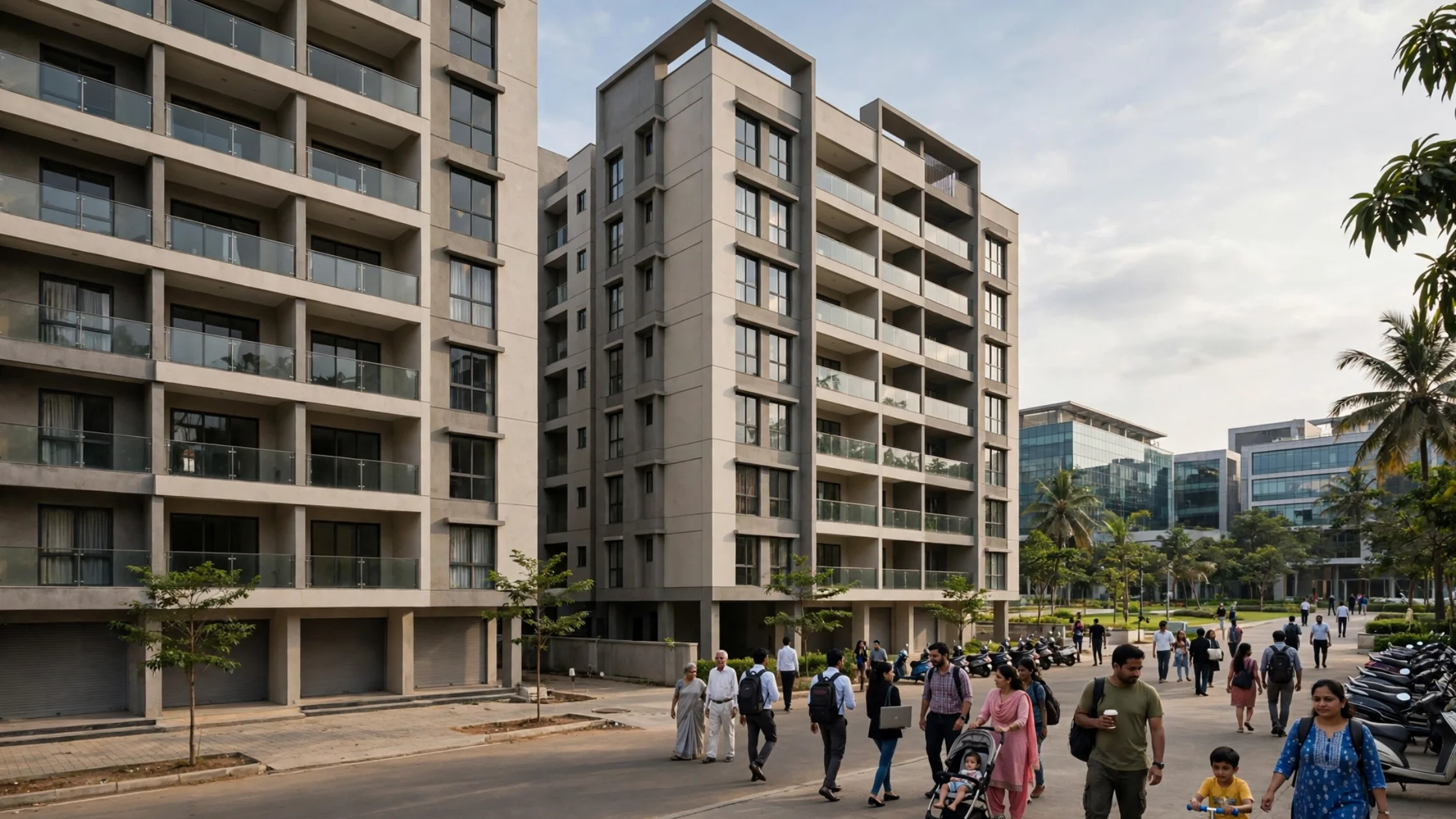
You bought a good-looking 2BHK, took possession, and the flat has now sat empty for eleven weeks. It happens more often than brokers admit. Rent here isn’t spread evenly: two apartments of identical size, twelve kilometres apart, can differ by twelve thousand rupees a month and by nearly a full percentage point in yield. That gap is why serious buyers study high rental yield areas in Bangalore before shortlisting a project, not after signing. Naverah Assets helps property seekers understand different locations and rental considerations before making a decision. This guide covers the corridors that rent quickly, the reasons behind it, and the expenses that quietly shave your returns. Naverah Assets recommends treating this as general information rather than investment advice.
Yield is annual rent divided by what you paid. Simple arithmetic, endlessly misquoted. A broker showing you 5% has usually used gross rent against a discounted base price and forgotten maintenance entirely.
Net yield subtracts what you actually pay: association maintenance, property tax, a month or two of vacancy, brokerage, and repairs. The drop from gross to net runs roughly 1 to 1.5 percentage points. A flat quoted at 4% gross is realistically doing 2.7% in your hand.
Capital values have outrun rents for a decade, and that compresses yield. Most of the expected return sits in appreciation, not monthly cash flow. If you need rent to service an EMI in full from day one, the maths rarely works without a large down payment.
Tenant demand here is deepest and most predictable. Whitefield’s older stock, especially projects finished a decade or more ago near ITPL and Varthur Road, delivers the strongest ratios because purchase prices never caught up to newer launches while rents did. Marathahalli works on volume: engineers wanting a 1BHK or a shared 2BHK within a fifteen-minute commute.
Sarjapur Road behaves differently. Rents are healthy, but land and launch prices climbed fast, so newer projects show weaker yield despite higher absolute rent. You trade a thinner monthly return for a corridor that keeps drawing offices and schools.
North Bangalore is the outlier worth studying. Thanisandra, Hennur and the stretches around Manyata Tech Park have a genuine employment anchor and prices below equivalent-quality east Bangalore stock. Yelahanka and the pockets nearer the airport road draw airline crew, hospitality staff and aviation families who sign longer leases.
Devanahalli itself is a weaker rental play today, whatever the appreciation story. Occupancy is thin, and an empty unit earns nothing however promising the land value chart looks. Among the rental income hotspots Bangalore landlords rely on, the ones with a working office cluster inside five kilometres beat the ones counting on a future one.
Not every good tenant works in software. Some of the steadiest rental return locations sit near hospitals, colleges and government offices, where demand is unglamorous but reliable. Several of the rental income hotspots Bangalore investors overlook completely are clustered around exactly these institutions.
• Around large hospitals on Bannerghatta Road and in Richmond Town: attendant families, resident doctors, nursing staff. Short leases, near-zero vacancy.
• Near established colleges in Jayanagar, Basavanagudi and Malleswaram: predictable annual cycles, though student turnover tests your patience.
• Older RMV, Sanjaynagar and Vidyaranyapura stock: modest rents, low entry prices on resale units, which is where high yield apartments Bangalore investors quietly accumulate.
• Electronic City Phase 1 and 2: solid yields, weaker appreciation, and a commute that lives or dies on the elevated corridor.
The pattern across these rental return locations is consistent. Yield is highest where the price is unfashionable and the demand is boring.
Figures below are indicative gross ranges for standard 2BHK apartments. They shift with project age, floor, furnishing and the month you ask.
| Corridor | Gross yield | Vacancy risk | Tenant profile |
|---|---|---|---|
| Whitefield (older projects) | 3.5% to 4.2% | Low | IT, families |
| Marathahalli | 3.5% to 4.0% | Very low | Young professionals |
| Sarjapur Road (new launches) | 2.8% to 3.4% | Low | Senior IT, families |
| Thanisandra / Hennur | 3.4% to 4.0% | Low | Manyata employees |
| Electronic City | 3.6% to 4.3% | Low | IT, manufacturing |
| Yelahanka | 3.0% to 3.6% | Moderate | Aviation, hospitality |
| Devanahalli | 2.2% to 3.0% | High | Limited |
| Indiranagar | 2.4% to 3.0% | Very low | Expats |

Location sets the ceiling. Your unit decides where inside that ceiling you land.
Compact units win on yield almost everywhere. A 1,050 sq ft 2BHK rents for more per square foot than a 1,750 sq ft 3BHK in the same tower, and it re-lets faster. The Bangalore rental market has a deep pool of tenants at the thirty to forty thousand rupee level and a thin one above sixty-five thousand. The high yield apartments Bangalore landlords hold onto longest tend to sit right in that band.
Semi-furnished is the sweet spot: wardrobes, modular kitchen, geysers, fans, lights. Fully furnished units command a premium but attract shorter tenancies and heavier wear. Skip the expensive sofa. Do fix the bathroom fittings.
None of the yield maths matters if the title is shaky. Before buying anything you intend to rent out, work through the basics:
1. Confirm RERA Karnataka registration and check the declared completion timeline against reality.
2. Insist on Khata A. B-Khata creates financing headaches and complicates resale, which caps your exit.
3. Pull a thirty-year encumbrance certificate and read the sale deed alongside the mother deed for an unbroken ownership chain.
4. Verify BBMP, BDA or BMRDA approval for the layout, and check the occupancy certificate before registration.
5. Budget stamp duty and registration charges into your cost base, since they change your true yield.
Register the rental agreement properly, keep it at eleven months, and hold the deposit to the two or three months tenants here now expect.
A gated community charging four rupees per square foot in maintenance takes a real bite out of a 3.8% gross yield. Add property tax, brokerage per tenant change, painting between tenancies, and the odd plumbing job. Landlords who track this find the best rental areas Bangalore offers aren’t always the ones with the flashiest amenities, because the clubhouse you rarely use still lands on your bill.
At prevailing home loan rates the first several years of EMI are mostly interest, so rent covering 55% to 65% of the EMI is normal rather than a failure.
For a standard apartment, expect roughly 3% to 4% gross in strong corridors and closer to 2.5% net after maintenance, tax, vacancy and brokerage. Older resale units in established tech belts sit at the upper end. Premium central localities deliver lower yield but shorter vacancy periods.
Apartments in gated projects rent faster and re-let more easily because tenants value security, water supply and parking. Independent houses can earn more in absolute rent, particularly if the ground floor is let separately, but they take longer to fill and demand more of your time as a landlord.
Rarely the same list. High rental yield areas in Bangalore tend to be mature, well-occupied and fully priced, while appreciation plays sit further out where occupancy is still building. Investors chasing both usually compromise on one, picking mid-corridor locations with existing employment and remaining land supply.
Semi-furnishing pays for itself in most segments. Wardrobes, a modular kitchen, geysers and lighting typically add several thousand rupees to monthly rent and cut vacancy noticeably. Full furnishing suits short-stay corporate tenants only, and furniture depreciation usually cancels out the extra rent within a few years.
Rental returns here reward unglamorous decisions. Compact configurations, established projects, a working office cluster within a short commute, and a price that wasn’t inflated by launch-day enthusiasm. The high rental yield areas in Bangalore that consistently perform are the ones where tenants already live, not the ones where they’re expected to arrive. Run your own numbers on net yield rather than gross, factor in a month of vacancy each year, and check the title paperwork before the spreadsheet. None of this is investment advice, and your tax position and borrowing costs shape the outcome as much as the postcode does.
If you’re weighing up your options, Naverah Assets can help you explore suitable properties and understand the local market. Connect with Naverah Assets for practical, location-focused guidance.
Follow us on Instagram for fresh property updates and market insights.


